
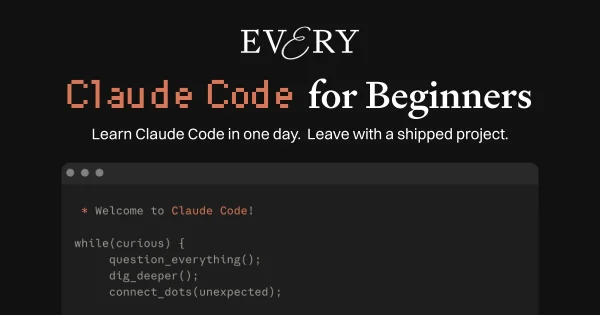
Dan Shipper – Claude Code for Beginners: A Complete Mastery Guide
Learning to code has never been more exciting than it is today. With the rise of AI-powered tools, beginners are no longer required to struggle through complex syntax guides or confusing documentation. Modern AI assistants help new developers learn faster, build smarter, and understand concepts more deeply. In this guide, inspired by the learning approach used in Dan Shipper – Claude Code for Beginners, we explore how anyone can start coding confidently—even with zero experience.
Whether you want to build websites, automate tasks, analyze data, or explore AI itself, this guide breaks everything down in simple, friendly, and practical language. No technical background required.
Table of Contents
Why Learning to Code Is Different Today
How AI Accelerates Your Coding Journey
Core Programming Concepts Every Beginner Must Know
Choosing the Right First Programming Language
Writing Your First Lines of Code
Building Confidence: How to Practice the Right Way
Step-by-Step Beginner Projects
How AI Helps You Debug and Improve Your Code
Best Practices for Clean, Future-Proof Code
How to Continue Growing as a Developer
Final Thoughts
1. Why Learning to Code Is Different Today
There was a time when learning to code meant reading 500-page textbooks or sitting through long, monotonous tutorials. Students had to memorize syntax, understand complex logic, and practice alone without immediate feedback.
But things have dramatically changed.
Today, AI tools make coding accessible to absolutely anyone. They act like a personal mentor—breaking concepts down, giving examples, and helping you understand why things work the way they do.
What used to take months can now be learned in weeks. You don’t have to feel stuck, confused, or overwhelmed. Coding today is about creativity, problem-solving, and building things that excite you.
2. How AI Accelerates Your Coding Journey
Beginners struggle with three common problems:
Syntax confusion
Lack of real-time feedback
Fear of making mistakes
AI solves all three.
AI Helps You Understand Concepts Clearly
Ask AI to explain loops, functions, or variables, and you’ll get clear examples tailored exactly to your level.
AI Helps You Start Building Immediately
Instead of spending days learning theory, you can start building simple projects fast. AI fills in gaps when you get stuck.
AI Helps You Fix Errors
Error messages often look scary for beginners. AI can translate those messages into plain language and show you what to fix.
AI Helps You Learn by Doing
You learn faster when you’re actually building things. AI gives feedback instantly, which keeps motivation high.
3. Core Programming Concepts Every Beginner Must Know
Before writing code, you must understand a few foundational ideas. Thankfully, these concepts are simple when explained with real-world examples.
Variables
Think of variables as labeled boxes where you store data—names, numbers, messages, anything.
Example:name = "Aarav"
Data Types
Every programming language uses different types of values:
String: text
Integer: whole number
Float: decimal
Boolean: True or False
Operators
Operators perform actions like addition, subtraction, comparison, or combining data.
Example:price + tax
Conditional Statements
These help programs make decisions.
Example:
Loops
Loops repeat sections of code automatically. Perfect when you need to perform the same action many times.
Functions
Functions are small programs inside a program. They help organize code and avoid repetition.
4. Choosing the Right First Programming Language
There are hundreds of languages, but beginners should start with one of these:
Python – Best overall
Easy to read
Used in AI, data science, automation
Very beginner-friendly
JavaScript – Best for web development
Runs in every browser
Perfect if you want to build websites or web apps
HTML & CSS – For visual learners
Helps you design beautiful websites
No complex logic needed initially
Why Python is typically recommended first
Python feels like writing English. Beginners pick it up in hours instead of weeks.
Example:
That’s a complete program!
5. Writing Your First Lines of Code
If you’re completely new, here’s a simple roadmap:
Step 1: Install a Code Editor
Popular beginner editors:
VS Code
PyCharm (for Python)
Replit (browser-based—no installation)
Step 2: Start With a Simple Program
A beginner’s first line of code is often:
This teaches:
How code is executed
How output works
How programs communicate with the user
Step 3: Make It Interactive
Add user input:
You’ve just built your first interactive program.
6. Building Confidence: How to Practice the Right Way
Many beginners quit coding not because it’s hard, but because they approach it incorrectly. Here’s how to learn efficiently:
1. Ask AI to Explain Everything in Your Own Words
If something is confusing, ask for a story-based explanation, analogy, or real-life example.
2. Learn in Tiny Steps
Break complex concepts into small learning blocks.
3. Build Mini-Projects Quickly
Don’t wait until you “know everything.” Build something today—even if it’s small.
4. Make Mistakes on Purpose
Trying incorrect code teaches more than perfect code ever will.
5. Rewrite Code in Your Style
Understanding comes from doing, not copying.
7. Step-by-Step Beginner Projects
Here are easy yet powerful projects that accelerate your learning:
Project 1: Personal Greeting App
Concepts covered: input, output, variables
Users enter their name and the program greets them.
Project 2: Simple Calculator
Concepts covered: operators, functions
A program that adds, subtracts, multiplies, or divides numbers.
Project 3: To-Do List App
Concepts covered: lists, loops
Users can add tasks and display them.
Project 4: Temperature Converter
Concepts covered: math formulas, conditionals
Converts Celsius to Fahrenheit and vice-versa.
Project 5: Password Strength Checker
Concepts covered: strings, logic
Checks if a password is strong using specific rules.
Why these projects matter
They’re small enough for beginners but powerful enough to build confidence and teach problem-solving.
8. How AI Helps You Debug and Improve Your Code
Debugging used to be the most frustrating part of learning coding. Now AI makes it simple.
By explaining error messages
Instead of confusing text, you’ll get plain-English explanations.
By suggesting improvements
AI can rewrite your code to make it cleaner and more efficient.
By teaching alternative solutions
You learn multiple approaches to solve the same problem.
By offering full walk-throughs
AI can guide you step-by-step until your project is complete.
9. Best Practices for Clean, Future-Proof Code
Writing code is one thing—writing good code is another. Here are essential best practices:
1. Use clear variable names
Instead of:
x = 10
Use:price = 10
2. Write short, focused functions
A function should do one thing exceptionally well.
3. Add comments
Comments help you remember what your code does.
4. Keep your code DRY
Don’t Repeat Yourself.
5. Organize your files properly
Good structure helps as your projects grow.
6. Test often, not at the end
Run your code frequently to catch issues early.
10. How to Continue Growing as a Developer
Once you understand the basics, continue learning with a structured plan:
Level 1: Improve Your Fundamentals
Learn loops thoroughly
Understand functions in depth
Practice conditionals with real examples
Level 2: Explore Specialized Areas
Depending on your interest:
Web development
Automation
Data science
App development
AI/ML
Level 3: Work on Real Projects
This is where true learning happens. Build:
Portfolio websites
Simple games
Automation scripts
Chatbots
Business tools
Level 4: Contribute to Open Source
This exposes you to real-world software and improves your technical confidence.
11. Final Thoughts
Learning to code no longer requires months of classroom study or memorizing complicated rules. Inspired by the structure of Dan Shipper – Claude Code for Beginners, this complete guide helps anyone—student, professional, or hobbyist—start writing code confidently.
The secret to becoming a good programmer is simple: start small, practice consistently, and use AI as your friendly mentor. The more you experiment, the faster you grow.
No matter your age, background, or skill level, you can start today. The tools are accessible. The support is available. The possibilities are limitless.



Reviews
There are no reviews yet.