
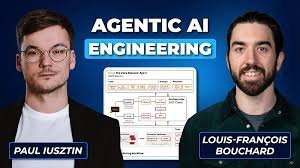
Artificial intelligence is evolving at an unprecedented pace. From basic machine learning models to advanced autonomous systems, the industry is now shifting toward agentic AI—systems capable of reasoning, planning, and acting independently. At the forefront of this transformation is Paul Iusztin – Agentic AI Engineering, a framework and educational ecosystem designed to help developers build next-generation AI agents.
In this in-depth guide, we explore what agentic AI engineering really means, how it differs from traditional AI development, key features, practical implementation steps, and whether it’s worth your time. If you are searching for a comprehensive review, tutorial, or roadmap to get started online, this article covers everything you need.
What Is Agentic AI Engineering?
Agentic AI engineering refers to the structured process of designing AI systems that can:
Make decisions autonomously
Plan multi-step actions
Interact with tools and APIs
Adapt based on feedback
Operate with minimal human intervention
Unlike static AI models that simply respond to prompts, agentic systems are dynamic. They maintain context, use memory, execute actions, and pursue goals.
Paul Iusztin – Agentic AI Engineering focuses specifically on building production-ready AI agents using modern frameworks, large language models (LLMs), orchestration layers, and real-world software engineering principles.
Why Agentic AI Is the Future of Development
AI is no longer just about generating text or images. Businesses now require AI that can:
Automate workflows
Perform research tasks
Manage projects
Execute transactions
Monitor systems
Agentic AI enables:
1. Multi-Step Reasoning
Agents can break complex tasks into smaller actions.
2. Tool Usage
They can call APIs, access databases, and interact with external systems.
3. Persistent Memory
Stateful systems allow agents to learn and improve over time.
4. Autonomous Decision-Making
Minimal supervision is required once goals are defined.
This is the engineering discipline behind intelligent digital workers.
Core Features of Paul Iusztin – Agentic AI Engineering
Below are the key features that make this approach stand out:
🔹 Practical Engineering Focus
Rather than theory-heavy discussions, the framework emphasizes:
Real-world system design
Scalable AI architecture
Deployment strategies
Production monitoring
🔹 LLM Integration
Modern agentic systems leverage:
OpenAI models
Anthropic Claude
Open-source LLMs
🔹 Tool-Oriented Design
Agents are built to interact with:
APIs
Databases
Search engines
File systems
🔹 Memory & State Management
Long-term memory layers allow:
Context persistence
Personalized outputs
Workflow tracking
🔹 Security & Guardrails
Responsible AI implementation includes:
Access control
Prompt validation
Output moderation
How It Differs From Traditional AI Courses
Many AI tutorials focus only on:
Prompt engineering
Fine-tuning models
Data preprocessing
However, Paul Iusztin – Agentic AI Engineering bridges the gap between AI theory and full-stack software engineering.
Traditional AI Development
Model-centric
Static outputs
Limited orchestration
Agentic AI Engineering
System-centric
Dynamic workflows
Autonomous execution
Tool chaining
This makes it particularly valuable for developers building SaaS platforms, automation systems, or AI startups.
Agentic AI Engineering Tutorial: Step-by-Step Overview
If you are looking for an Agentic AI Engineering tutorial online, here is a simplified roadmap inspired by the methodology:
Step 1: Define the Agent’s Goal
Clearly outline:
Task objective
Success criteria
Required tools
Step 2: Choose the LLM Backbone
Select a model based on:
Cost efficiency
Speed
Accuracy
Context window
Step 3: Implement Memory
Use:
Vector databases
Short-term session memory
Persistent state storage
Step 4: Tool Integration
Connect:
Web search APIs
Internal company APIs
Data processing modules
Step 5: Orchestration Layer
Frameworks often used include:
LangChain
AutoGen
Custom orchestration pipelines
Step 6: Evaluation & Monitoring
Test:
Task completion rates
Hallucination frequency
Execution stability
This engineering-first process is what makes Paul Iusztin – Agentic AI Engineering particularly powerful for real-world applications.
Installation & Setup Overview
If you are searching for how to install Agentic AI Engineering environments, here is a general setup process:
Basic Requirements
Python 3.10+
Virtual environment
API keys (OpenAI or others)
Database (optional but recommended)
Typical Installation Steps
Create virtual environment
Install required dependencies
Configure API credentials
Set up vector database
Run local agent server
While some users look for free download versions or crack alternatives, it is strongly recommended to use official resources and legitimate tools for security and stability.
Is There a Free Version Available?
Many developers search for:
Agentic AI Engineering free
Agentic AI Engineering download
Agentic AI Engineering crack
Agentic AI Engineering latest version
While some educational materials or tutorials may be available online, accessing pirated or cracked versions is not recommended. Not only is it unethical, but it also poses security risks.
Instead, focus on:
Official documentation
Community tutorials
Open-source frameworks
Public GitHub repositories
Real-World Applications
The methodologies behind Paul Iusztin – Agentic AI Engineering can be applied across industries.
SaaS Automation
Automated customer support
CRM updates
Data enrichment
Research Assistants
Multi-source data aggregation
Report generation
Trend analysis
Developer Tools
Code generation agents
Debugging assistants
CI/CD automation
Enterprise Workflows
Document processing
Financial reconciliation
Risk assessment
The scalability of agentic systems makes them ideal for startups and enterprises alike.
Performance & Scalability Considerations
When building agentic systems, consider:
Latency
Multi-step reasoning increases response time.
Cost
LLM API calls accumulate quickly.
Reliability
Agents must handle:
API failures
Timeouts
Incorrect outputs
Monitoring
Production systems need:
Logging
Alerting
Version control
This engineering rigor is central to Paul Iusztin – Agentic AI Engineering.
Pros and Cons
✅ Pros
Production-ready mindset
Practical implementation focus
Modern LLM integration
Real-world case studies
❌ Cons
Requires programming knowledge
Higher infrastructure costs
Not beginner-level
Who Should Learn Agentic AI Engineering?
This approach is ideal for:
AI engineers
Backend developers
SaaS founders
Automation specialists
Technical product managers
If you want to move beyond simple chatbot creation and into autonomous system development, this is the right direction.
Common Mistakes to Avoid
When implementing agentic AI systems:
Overcomplicating architecture
Ignoring security guardrails
Failing to evaluate outputs
Not optimizing API costs
Skipping monitoring
Learning from structured methodologies like Paul Iusztin – Agentic AI Engineering helps avoid these pitfalls.
Future of Agentic AI
The next generation of AI will likely include:
Fully autonomous business agents
Self-improving systems
Multi-agent collaboration
Cross-platform execution
As AI agents become more capable, engineering discipline will become more important than ever.
FAQs
What is Paul Iusztin – Agentic AI Engineering?
It is a structured approach to building autonomous AI systems that can reason, plan, and execute tasks using modern LLM technologies.
Is there a Paul Iusztin – Agentic AI Engineering free download?
While some tutorials may be available online, always rely on official and legitimate sources rather than cracked versions.
How do I install Agentic AI Engineering tools?
You typically need Python, API keys, orchestration frameworks, and optional vector databases for memory management.
Is Agentic AI Engineering suitable for beginners?
It is more suitable for intermediate to advanced developers who understand APIs, backend systems, and LLM integration.
What makes Paul Iusztin – Agentic AI Engineering different from other AI tutorials?
It emphasizes production-ready architecture, autonomous agents, and full-system engineering rather than only prompt engineering.
Final Verdict
The AI industry is shifting from simple predictive models to fully autonomous digital agents. Understanding how to build these systems is becoming a high-value skill.
Paul Iusztin – Agentic AI Engineering stands out because it focuses on practical, scalable, and secure implementation of agent-based systems. Rather than just teaching theory, it prepares developers to design AI architectures that work in real-world production environments.
If you are serious about building autonomous AI products, mastering agentic AI engineering principles is no longer optional—it is essential.



Reviews
There are no reviews yet.